

The Authority in Global Agricultural Chemistry & Bio-Resources
Collagen Stimulation Technology Explained: RF, Microneedling, and HIFU Differences
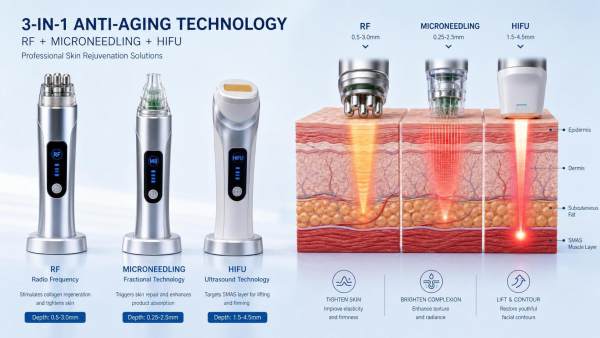
Collagen stimulation technology sits at the center of today’s anti-aging device landscape because it links visible skin outcomes with measurable energy delivery. For platform comparison, the real question is not whether RF, microneedling, or HIFU stimulate collagen, but how each one does it, at what depth, with what thermal profile, and under which safety controls.
That distinction matters across the broader appearance economy tracked by AECS, where clinic-grade systems, home beauty devices, and compliance-driven product strategies increasingly overlap. A useful evaluation starts with tissue targeting, then moves to treatment logic, repeatability, downtime, and the evidence supporting collagen remodeling over time.
Why collagen stimulation technology attracts so much attention
Skin aging is not only a surface issue. It involves collagen fragmentation, elastin decline, reduced fibroblast activity, and gradual structural laxity in deeper layers.
Because of that, collagen stimulation technology is valued for structural remodeling rather than short-lived masking effects. It aims to trigger wound-healing or thermal-repair pathways that encourage new collagen formation.
In practical evaluation, this changes the benchmark. Immediate tightening may look impressive, but sustained neocollagenesis, treatment consistency, and risk control usually matter more.
This is also why the field spans multiple device categories. The same collagen-focused objective appears in medical aesthetic optoelectronic systems, energy-based home devices, and hybrid platforms designed for broader consumer care portfolios.
Three pathways, one remodeling goal
RF, microneedling, and HIFU all belong to collagen stimulation technology, yet their mechanisms are fundamentally different. Their clinical logic comes from the way energy enters tissue.
RF: volumetric dermal heating
Radio frequency creates heat through electrical resistance within tissue. The target is usually the dermis, where controlled heating can denature collagen and activate fibroblast repair responses.
The important point is heating pattern. Monopolar, bipolar, multipolar, and fractional RF do not behave the same way. Depth, dispersion, and epidermal protection vary greatly by configuration.
Microneedling: mechanical injury, sometimes combined with RF
Traditional microneedling stimulates collagen by creating controlled micro-injuries. That mechanical disruption activates wound-healing cascades and can improve texture, pores, and superficial scarring.
When RF is added through insulated or non-insulated needles, the modality changes significantly. It becomes a more targeted form of collagen stimulation technology, combining puncture depth with thermal coagulation zones.
HIFU: focal thermal coagulation at depth
High-intensity focused ultrasound concentrates acoustic energy into precise focal points. It bypasses the surface and generates thermal coagulation deeper in tissue, including the deep dermis and, in some systems, the SMAS layer.
That is why HIFU is often associated with lifting logic rather than resurfacing logic. It is less about broad dermal heating and more about deep structural contraction and remodeling.
Where the differences become meaningful
On paper, all three technologies stimulate collagen. In evaluation, their differences become clear when comparing target depth, lesion geometry, pain profile, recovery, and application goals.
A comparison like this helps, but it is still incomplete. The real performance gap often comes from energy control quality, coupling design, applicator engineering, and operator dependence.
Depth is only one part of the decision
It is tempting to rank collagen stimulation technology by penetration depth alone. That usually leads to poor decisions.
A deeper target does not automatically mean a better result. Tissue response depends on thermal threshold, lesion uniformity, spacing, pulse duration, and the biological condition of the skin being treated.
For example, RF may outperform HIFU in repeatable maintenance programs where broad dermal heating and manageable recovery are priorities. Microneedling may outperform both for texture-led programs where controlled superficial injury matters more than lifting.
This is particularly relevant in the AECS view of the market, where clinic platforms and home-use derivatives are no longer evaluated separately. Energy architecture, safety margins, and use frequency shape the category logic.
How RF, microneedling, and HIFU map to real use scenarios
A practical review of collagen stimulation technology should connect mechanisms to treatment intent. Most misalignment happens when the platform goal is vague.
When skin quality leads the agenda
For fine texture, visible pores, superficial acne scars, and early aging changes, microneedling often has a clear rationale. Fractional RF microneedling extends that logic by adding thermal zones.
When tightening must stay versatile
RF platforms are often chosen when the aim includes moderate tightening, broad applicability, and protocol flexibility. They can fit clinic settings, combination plans, and selected home-beauty adaptations.
When deeper lifting is the priority
HIFU stands out when deeper tissue engagement matters more than surface refinement. Jawline support, lower-face laxity, and non-surgical lift positioning typically drive interest here.
- Use RF when treatment cadence, thermal comfort, and broad dermal stimulation are central.
- Use microneedling when remodeling needs visible surface improvement as well as collagen activation.
- Use HIFU when deeper structural tightening is more important than resurfacing.
Evaluation points that deserve closer scrutiny
For any collagen stimulation technology review, device labels alone are not enough. Two systems using the same category name can perform very differently.
Energy delivery integrity
Check whether output is stable across tissue impedance changes, cartridge wear, and prolonged sessions. Claimed power means little without repeatability.
Thermal and mechanical safeguards
Cooling, contact sensing, depth control, and coupling verification are essential. These features often separate robust platforms from visually similar ones.
Protocol realism
Look beyond best-case outcomes. Consider treatment duration, consumables, pain management, maintenance frequency, and learning curve.
Regulatory and positioning logic
In the current market, classification risk matters. Home-use RF and adjacent anti-aging devices are receiving more regulatory attention from authorities including FDA and NMPA.
That makes claim language, safety data, and intended-use boundaries part of technical evaluation, not just legal review. AECS treats this intersection as a core industry signal.
What a balanced selection framework looks like
The most useful way to compare collagen stimulation technology is to build a weighted framework rather than chase a single “best” modality.
- Match tissue depth to treatment goal instead of headline specifications.
- Separate immediate contraction effects from long-term collagen remodeling evidence.
- Review safety architecture with the same seriousness as efficacy claims.
- Test whether the platform fits clinic, hybrid, or consumer-care pathways.
- Compare workflow burden, consumable dependence, and operator sensitivity.
That approach creates a clearer picture of commercial fit and technical resilience. It also reflects how the anti-aging device sector is evolving: not as isolated technologies, but as integrated systems competing on performance, safety, and positioning.
A sensible next step
RF, microneedling, and HIFU each represent a valid branch of collagen stimulation technology, but they solve different problems with different biological routes. Good evaluation depends on seeing those routes clearly.
The next move is to compare platforms against a structured matrix: target depth, lesion pattern, safety controls, treatment cadence, claim boundaries, and evidence quality. Once those elements are mapped, the differences stop looking like marketing language and start becoming usable technical judgment.
Related Intelligence
- Optoelectronics & Dermal TechAesthetic Equipment Comparison Chart: Treatment Uses, Skin Types, and DowntimeExplore our aesthetic equipment comparison chart to compare treatment uses, skin-type suitability, and downtime. Discover key safety checks and make smarter device purchasing decisions.
- Optoelectronics & Dermal TechChoosing a Collagen Stimulation Device Manufacturer: Evidence and Quality ChecksChoose a collagen stimulation technology manufacturer with confidence. Learn how to verify clinical evidence, regulatory status, production quality, and service before you buy.
- Optoelectronics & Dermal TechAesthetic Device Solutions: What Multi-Treatment Clinics Should EvaluateAesthetic device solutions for multi-treatment clinics: evaluate safety, workflow, versatility, lifecycle costs, and supplier support before investing.
The Morning Broadsheet
Daily chemical briefings, market shifts, and peer-reviewed summaries delivered to your terminal.
