

The Authority in Global Agricultural Chemistry & Bio-Resources
Nano emulsification affects texture, stability, and fill accuracy
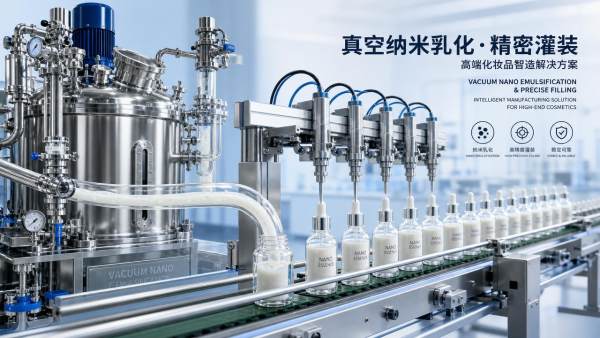
For technical evaluators in cosmetic equipment and process engineering, nano emulsification is more than a formulation step—it directly influences product texture, long-term stability, and filling precision on automated lines. Understanding how droplet size distribution, shear control, and system design interact is essential for assessing whether a process can deliver both premium sensory performance and reliable manufacturing accuracy.
Why does nano emulsification matter so much in automated cosmetic manufacturing?
In beauty and personal care production, technical evaluation rarely stops at whether an emulsion can be formed. The harder question is whether nano emulsification can maintain uniformity from batch preparation to transfer, storage, dosing, filling, sealing, and final shelf life.
For premium serums, lotions, oral care gels, and essence concentrates, droplet scale affects more than appearance. It shapes viscosity behavior, gloss, spreadability, active dispersion, bubble retention, pumpability, and the consistency of each filled unit on high-speed lines.
This is where AECS brings unusual value. The platform connects fluid dynamics, thermal control, process equipment logic, and downstream packaging performance. That cross-disciplinary view is critical because nano emulsification failures often appear later as leakage, underfill, foaming, unstable texture, or consumer complaints.
- Smaller and more uniform droplets usually improve sensory smoothness and visual refinement, especially in high-end skincare and ampoule-type products.
- A tighter droplet size distribution can reduce creaming, coalescence, and phase separation when formulation chemistry is properly matched.
- Stable rheology under processing stress helps filling valves, pumps, and nozzles perform with better repeatability and less drift.
- Controlled shear and vacuum conditions can lower entrapped air, which directly supports more accurate fill weights and cleaner sealing results.
What technical evaluators are really checking
A formulation may look elegant in a laboratory beaker and still fail industrial review. Evaluators are typically checking whether the nano emulsification process is scalable, whether process windows are repeatable, and whether the final product remains stable under realistic storage and transport conditions.
They also need to know whether the equipment architecture supports validation. In practice, this means asking how rotor-stator geometry, vacuum level, heat exchange efficiency, recirculation path, CIP design, and instrumentation affect output consistency rather than just headline emulsification speed.
How nano emulsification changes texture, stability, and fill accuracy
The most useful way to assess nano emulsification is to link three outcomes: sensory texture, physical stability, and dosing precision. These outcomes are connected, not separate. A process that produces unstable microstructure often causes unstable viscosity, and unstable viscosity commonly shows up as fill variation.
The table below helps technical evaluators map the process variables of nano emulsification to downstream manufacturing and product-performance consequences.
For evaluators, the key takeaway is simple: fill accuracy is often a symptom. When a production team reports inconsistent weights, dripping nozzles, or unstable cycle time, the root cause may sit upstream in nano emulsification quality rather than in the filling head alone.
Texture: where premium feel begins
Consumers interpret smoothness, richness, drag, breakability, and after-feel within seconds. Nano emulsification influences these properties by changing droplet fineness and interfacial organization. A finer and narrower droplet distribution often creates a more refined, less greasy, more even application profile.
That matters across AECS-covered sectors. In facial emulsions, elegant slip supports premium positioning. In oral care concentrates, dispersion quality influences mouthfeel. In scalp or hair serums, poor emulsification can create uneven deposition or visible oiling during use.
Stability: where shelf life is won or lost
Nano emulsification does not guarantee stability by itself, but it can materially improve the physical foundation of the system. Smaller droplets settle or cream differently, and more uniform populations are typically easier to stabilize with the right emulsifier package and viscosity profile.
Technical evaluators should still verify heat-cool cycling, centrifuge screening, long-term storage observation, and compatibility with active ingredients. The most common mistake is to confuse initial visual elegance with actual storage robustness.
Fill accuracy: the hidden operational dividend
On automated cosmetic lines, product flow behavior drives dosing consistency. If nano emulsification produces an emulsion with stable rheology, low aeration, and controlled thixotropy, then piston, gear, or servo filling systems usually perform more predictably. That reduces giveaway, rework, and line stoppages.
Which technical parameters deserve the closest attention?
When reviewing a nano emulsification line or vacuum homogenizer, evaluators should not rely on one metric such as maximum speed. A practical assessment combines formulation behavior, mechanical design, instrumentation, sanitation, and scale-up logic.
- Rotor-stator tip speed and shear profile, because intense shear is useful only when it matches the formulation’s breakup and stabilization mechanism.
- Batch circulation path, because dead zones or weak turnover reduce uniformity even when installed power looks sufficient on paper.
- Vacuum depth and degassing efficiency, because trapped bubbles directly influence density and fill repeatability.
- Heating and cooling response, because many emulsions are process-temperature sensitive and can shift rapidly during transfer to fillers.
- Inline measurement capability, such as temperature, pressure, speed, and timing records needed for process validation.
A practical parameter review table for nano emulsification projects
The following table is useful during supplier comparison, FAT preparation, or internal technical review. It keeps the nano emulsification discussion focused on measurable evaluation points instead of marketing labels.
This review framework also helps separate suitable suppliers for premium skincare and oral care from vendors who only offer generic mixing claims. For technical evaluators, the goal is not the strongest machine, but the most controllable process window.
How should you compare nano emulsification options during procurement?
Procurement decisions often fail when teams compare equipment by capacity and price alone. In reality, nano emulsification performance depends on formulation type, batch size variability, filling speed, packaging format, and cleaning frequency. A low-cost choice can create costly instability later.
Common equipment or process routes
Different manufacturing environments may choose different routes depending on throughput, sensitivity of actives, and finish requirements. The comparison below supports early-stage technical and commercial screening.
For high-end aesthetic and everyday care products, vacuum-based nano emulsification often offers the best balance between product feel and manufacturing control. That is especially true when the line must fill multiple formats, from glass bottles to airless packs and flexible sachets.
A procurement checklist for technical evaluators
- Define the formulation family first: serum emulsion, cream, oral care gel, or active-rich concentrate all behave differently under shear.
- Map target viscosity at filling temperature, not just at room temperature, because line performance depends on transfer condition.
- Request evidence of repeatability across at least several production-equivalent batches, not only one successful trial.
- Check whether the supplier can discuss integration with filling, capping, sealing, and CIP procedures.
- Review documentation readiness for validation, maintenance, and operator training.
What risks and misconceptions should be avoided?
Technical teams often overestimate the value of droplet reduction alone. Nano emulsification is important, but not independent from surfactant choice, oil-phase design, solids content, process temperature, deaeration, and packaging compatibility. A weak overall system can still fail even with fine droplets.
Frequent misconceptions
- Assuming smaller droplets always mean better stability. In some systems, interfacial stress or ingredient incompatibility can still cause breakdown.
- Treating fill accuracy as a filler-only issue. Product aeration and rheology shifts often begin in the emulsification stage.
- Using pilot-scale results without scale-up verification. Residence time and circulation behavior can change significantly at production volume.
- Ignoring cleaning design. Residue in valves, transfer paths, or dead corners can distort later batches and create quality deviations.
AECS is particularly relevant here because many failures are interdisciplinary. The answer may involve fluid dynamic behavior, thermal gradients, packaging response, or even compliance implications when process instability affects claim support and product consistency documentation.
FAQ: nano emulsification questions technical evaluators ask most
How do I know whether nano emulsification is necessary for my product?
It is usually worth strong consideration when your product targets premium texture, contains sensitive actives, needs long shelf stability, or runs on high-speed filling lines where viscosity consistency matters. It becomes even more relevant for export-oriented brands where repeatability and documentation are closely reviewed.
Which scenarios benefit most from tighter droplet size control?
Facial essences, anti-aging emulsions, oral care suspensive gels, and visually clear or semi-translucent premium products are common examples. These applications are highly sensitive to sensory refinement, storage appearance, and dosing consistency.
What should I prioritize when comparing suppliers?
Prioritize repeatability data, vacuum and thermal control logic, integration with filling systems, cleanability, and documentation support. A supplier who can explain how nano emulsification affects downstream packaging performance is often more useful than one who only promotes motor power or vessel size.
Can nano emulsification reduce filling errors immediately?
It can help materially, but only when the whole process is aligned. If the emulsion remains aerated, temperature drifts during transfer, or the filler is mismatched to product rheology, errors may persist. Evaluators should review the mixing-to-filling chain as one system.
Why choose AECS for technical assessment and next-step planning?
AECS is built for decision-makers who need more than supplier brochures. Its strength lies in linking process physics, equipment architecture, compliance awareness, and commercial practicality across aesthetic devices, personal care appliances, oral care technologies, and cosmetic automated production lines.
If your team is evaluating nano emulsification for new product launch, line upgrade, OEM qualification, or export-focused manufacturing, AECS can support a more disciplined review path. Discussions can focus on parameter confirmation, solution selection, filling compatibility, delivery timing, customization direction, validation concerns, and sample or trial planning.
Contact AECS when you need practical guidance on vacuum homogenizing configuration, nano emulsification process windows, droplet-control implications for texture and stability, or the technical checkpoints that influence fill accuracy on automated lines. That conversation is often the difference between a visually good trial and a reliably manufacturable product.
Related Intelligence
- Vacuum Emulsifying MixersChoosing an Emulsification Equipment Supplier: Product Trials and After-Sales SupportChoose an emulsification equipment supplier with confidence. Learn how to assess product trials, scale-up, spare parts, and after-sales support to reduce risk and protect production.
- Vacuum Emulsifying MixersHow to Specify Cosmetic Processing Equipment for Viscosity, Batch Size, and CleanabilityCosmetic processing equipment guide: match viscosity, batch size, mixing, heat transfer, transfer, and CIP cleanability for reliable cosmetic production.
- Vacuum Emulsifying MixersHow to Choose Vacuum Emulsifiers for Skincare Creams and LotionsVacuum emulsifiers for skincare: learn how to select the right system for stable creams and lotions, with guidance on shear, vacuum, hygiene, automation, and scale-up.
The Morning Broadsheet
Daily chemical briefings, market shifts, and peer-reviewed summaries delivered to your terminal.
