

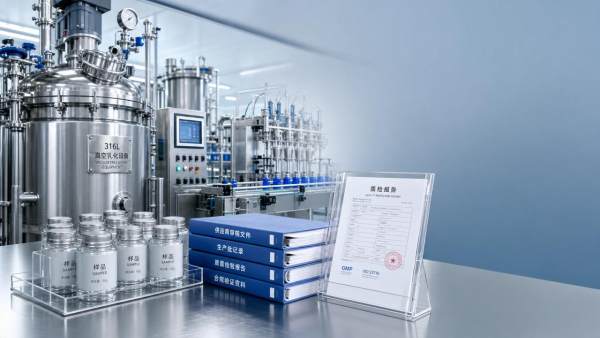
Choosing the right cosmetic manufacturing equipment supplier is a high-stakes decision for procurement teams, affecting stability, compliance, quality, and long-term cost control.
In a market driven by faster beauty launches and stricter safety standards, buyers need more than a price quote. They need a structured vetting framework.
This guide explains how procurement teams can evaluate technical capability, validation support, service reliability, delivery control, and total ownership cost before committing.
Start with the real procurement question: can this supplier reduce operational risk?
Most procurement failures begin when equipment is evaluated mainly by purchase price, machine speed, or polished sales presentations rather than production risk.
A qualified cosmetic manufacturing equipment supplier should help your plant produce consistent emulsions, fill accurately, clean efficiently, document compliance, and recover quickly after faults.
For buyers, the core question is not whether the supplier can build a machine. It is whether they can support your production reality.
That reality may include unstable raw materials, frequent formula changes, small-batch launches, export documentation, operator turnover, and demanding brand owners.
Procurement teams should therefore treat supplier vetting as a cross-functional assessment involving production, quality, engineering, maintenance, finance, and regulatory stakeholders.
Define your application before comparing suppliers
Before requesting quotations, clarify the exact products, formats, capacities, and hygiene requirements your equipment must support in daily operation.
Cosmetic manufacturing equipment may include vacuum emulsifying mixers, homogenizers, storage tanks, transfer systems, filling machines, capping systems, labeling units, and packaging lines.
Each category has different risk points. A cream mixer requires strong control of vacuum, shear, heating, cooling, and cleanability.
A filling line must manage viscosity variation, dosing accuracy, container tolerance, sealing performance, and changeover speed without excessive product waste.
Procurement teams should prepare a user requirement specification, often called a URS, before supplier shortlisting begins.
The URS should define product viscosity ranges, batch sizes, target output, container types, utilities, materials, automation level, cleaning approach, and documentation needs.
A supplier that responds with thoughtful technical questions is usually stronger than one that immediately sends a generic quotation.
Evaluate process knowledge, not only machine fabrication
Good cosmetic equipment suppliers understand cosmetic processing, not just welding, motors, pumps, and control cabinets.
They should know how emulsification stability, air incorporation, temperature profiles, powder dispersion, and shear energy affect product texture and appearance.
For creams, lotions, gels, serums, masks, and sunscreens, small process differences can lead to separation, foaming, graininess, color shift, or filling instability.
Ask the supplier to explain how their equipment handles your most difficult formula, not only your easiest product.
For example, high-viscosity creams may require wall scraping, bottom homogenization, controlled vacuum, and smooth discharge paths to reduce residue.
Low-viscosity toners may need filling systems optimized for anti-drip control, foam suppression, and fast format changes.
A capable supplier should translate formula behavior into mechanical design choices, automation logic, and operating parameters.
Check engineering quality and material standards carefully
Cosmetic production demands equipment that is hygienic, durable, and compatible with active ingredients, fragrances, alcohol, surfactants, oils, and cleaning agents.
Procurement teams should verify contact material grades, surface finish, weld quality, gasket compatibility, pipe dead legs, drainage design, and cleaning accessibility.
Stainless steel 316L is often preferred for product contact surfaces, especially when formulas contain aggressive ingredients or require higher corrosion resistance.
However, material grade alone is not enough. Poor polishing, rough welds, or hidden product traps can still create contamination risk.
Ask suppliers for material certificates, surface roughness values, welding documentation, and examples of hygienic design for similar applications.
Electrical and pneumatic components also matter. Reliable international components may simplify maintenance, spare parts sourcing, and future upgrades.
If the supplier uses alternative components, require clear documentation, expected service life, replacement availability, and compatibility with your maintenance capabilities.
Assess automation capability and data readiness
Modern cosmetic manufacturing increasingly depends on automation for consistency, traceability, labor efficiency, and faster scale-up from pilot to commercial batches.
A strong supplier should offer control systems that are stable, understandable, and appropriate for your factory’s actual digital maturity.
For some plants, basic PLC control with clear human-machine interface screens may be sufficient and easier to maintain.
For regulated or export-oriented operations, recipe management, batch records, alarm logs, access levels, and data export may become essential.
Procurement should ask how recipes are stored, how parameter changes are tracked, and how operator permissions are controlled.
Also confirm whether the system can integrate with weighing systems, barcode scanning, MES platforms, ERP systems, or quality databases.
Do not overbuy automation for appearance. The right level should reduce errors, support audits, and fit your operators’ training level.
Review compliance support and validation documentation
For cosmetic manufacturers supplying global brands, documentation can be as important as mechanical performance.
A cosmetic manufacturing equipment supplier should understand GMP expectations, hygienic design principles, electrical safety, risk assessment, and validation workflows.
Depending on your markets, relevant frameworks may include ISO 22716, CE requirements, local electrical standards, and customer-specific audit protocols.
Procurement teams should request sample documentation packages before signing, not after equipment delivery.
Useful documents include design specifications, material certificates, FAT protocols, SAT protocols, operating manuals, maintenance plans, wiring diagrams, and spare parts lists.
For higher-compliance environments, ask about installation qualification, operational qualification, and performance qualification support.
A supplier that cannot provide organized documents during sales evaluation may also struggle during audits, commissioning, and change control.
Use FAT and sample testing to verify real performance
Factory acceptance testing is one of the strongest tools procurement teams have for reducing uncertainty before shipment.
The FAT should test not only machine movement, but also production conditions that resemble your real factory requirements.
For mixing equipment, evaluate heating and cooling rates, vacuum holding, homogenizer stability, scraping performance, discharge efficiency, and cleaning accessibility.
For filling and packaging equipment, test dosing accuracy, speed stability, container handling, cap torque, sealing quality, rejection logic, and changeover procedures.
If possible, send representative formulas, containers, caps, films, labels, or packaging materials for trial runs.
Procurement should define acceptance criteria in writing, including tolerances, output targets, defect limits, and corrective action responsibilities.
Video demonstrations are useful, but they should not replace structured testing, especially for custom or high-value production lines.
Investigate delivery reliability and project management discipline
Late equipment delivery can disrupt product launches, contract manufacturing commitments, facility readiness, and cash flow planning.
A reliable supplier should provide a realistic project timeline with design approval, procurement, fabrication, assembly, testing, shipment, installation, and training milestones.
Procurement teams should ask how changes are controlled and how delays are communicated when component shortages or design revisions occur.
For international purchases, confirm responsibilities for packaging, export documents, shipping terms, customs support, insurance, and destination handling.
Large cosmetic production lines often require coordination between facility utilities, cleanroom layout, compressed air, purified water, drainage, and electrical capacity.
A disciplined supplier will ask for layout drawings and utility information early, then identify conflicts before equipment arrives.
If the supplier cannot manage technical communication before payment, expect greater difficulty during installation and commissioning.
Scrutinize after-sales service, spare parts, and training
Equipment value is proven after months of operation, not during the sales presentation.
Procurement teams should evaluate how quickly the supplier can support breakdowns, parameter issues, software faults, and urgent spare part needs.
Ask whether service is available through local technicians, regional partners, remote diagnostics, or factory engineering teams.
Clarify response times, warranty scope, excluded parts, travel charges, software support, and long-term spare parts availability.
Training should include operators, maintenance staff, quality personnel, and supervisors, because each group interacts with equipment differently.
Operator training should cover startup, shutdown, cleaning, changeover, alarms, and safe handling of abnormal conditions.
Maintenance training should address lubrication, calibration, belt replacement, pump checks, sensor troubleshooting, and recommended preventive maintenance schedules.
Compare total cost of ownership, not just quotation price
A lower-priced supplier may become expensive if the equipment wastes product, requires frequent repair, or cannot pass customer audits.
Total cost of ownership includes purchase price, installation, validation, utilities, labor, maintenance, spare parts, downtime, yield loss, and future modifications.
Procurement should model costs over several years, especially for high-throughput filling lines or core emulsification systems.
Energy efficiency can matter when heating, cooling, vacuum, compressed air, or high-speed motors operate for long production shifts.
Changeover time also has financial value, particularly for manufacturers producing many SKUs, seasonal launches, or private-label batches.
Ask suppliers to estimate changeover duration, cleaning time, product residue, and expected output under realistic operating conditions.
The best decision is rarely the cheapest machine. It is the supplier offering the strongest balance of performance, reliability, compliance, and lifecycle support.
Verify supplier credibility through evidence
Credibility should be proven by evidence, not only by brochures, exhibition booths, or impressive factory photographs.
Request case studies from similar product categories, machine types, output levels, and regulatory expectations.
Where possible, speak with existing customers about delivery accuracy, commissioning quality, downtime experience, and after-sales responsiveness.
Procurement teams should also assess the supplier’s financial stability, manufacturing capacity, engineering team size, and quality control procedures.
Factory audits can reveal whether production is organized, parts are traceable, inspection records are maintained, and testing areas are properly equipped.
During audits, observe how staff answer technical questions. Strong suppliers usually have engineers who can explain decisions without relying only on sales teams.
For overseas suppliers, evaluate English documentation quality, communication speed, time zone support, and experience with international shipping requirements.
Build a practical supplier scorecard
A structured scorecard helps procurement avoid emotional decisions and makes supplier comparison transparent to internal stakeholders.
Typical scoring categories include technical fit, hygienic design, automation capability, documentation, validation support, service strength, delivery confidence, and total cost.
Assign higher weight to factors that directly affect production continuity, compliance exposure, and product quality.
For example, a basic storage tank may place more weight on material quality and delivery time.
A fully automated filling and packaging line should place heavier weight on integration experience, FAT performance, service response, and changeover efficiency.
Include red-flag criteria that can disqualify a supplier regardless of total score.
Red flags include vague documentation, refusal to run meaningful tests, unclear component sourcing, weak service commitments, and unrealistic promises about delivery or performance.
Questions procurement teams should ask before awarding a contract
Before final negotiation, procurement should ask direct questions that reveal technical depth and operational responsibility.
Which similar projects have you completed, and can you provide references from comparable cosmetic manufacturers?
How will your design handle our most difficult formula, highest viscosity, smallest container, or fastest changeover requirement?
What documentation will be delivered with the equipment, and can we review samples before contract signing?
What exactly will be tested during FAT, and who is responsible if acceptance criteria are not met?
How quickly can you supply critical spare parts, and which parts should we keep in our own inventory?
Who will support installation, operator training, maintenance training, software troubleshooting, and post-warranty service?
These questions help move the conversation from price negotiation to operational accountability, which is where supplier quality becomes visible.
Final decision: choose the supplier that protects production, quality, and compliance
Vetting a cosmetic manufacturing equipment supplier is ultimately about protecting the factory’s ability to produce safe, consistent, and commercially competitive beauty products.
Procurement teams should look beyond equipment appearance and compare suppliers through evidence, testing, documentation, service capability, and lifecycle economics.
The right supplier will challenge unclear requirements, explain technical trade-offs, support validation, and remain accountable after installation.
The wrong supplier may offer a lower upfront price while transferring hidden risk to production, quality, maintenance, and customer relationships.
A disciplined vetting process gives buyers stronger negotiation power and reduces the chance of costly surprises after commissioning.
For cosmetic manufacturers operating in fast-moving and compliance-sensitive markets, supplier selection should be treated as a strategic procurement decision.
When the chosen partner can align engineering, hygiene, automation, documentation, and service, equipment becomes more than a machine.
It becomes a reliable production foundation for faster launches, stronger quality confidence, and sustainable long-term manufacturing performance.
