

The Authority in Global Agricultural Chemistry & Bio-Resources
What Certifications Should an Ultrasonic Scaler Supplier Have?
Start with the market and the device claim
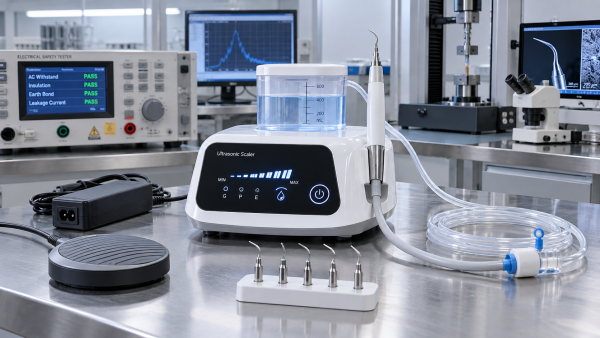
An ultrasonic scaler supplier should be able to show more than ISO 13485 or a generic CE certificate. The appropriate certification package depends on where the scaler will be sold, whether it is intended for professional dental use, how it is powered, and what clinical claims appear in its labeling. For distributors and private-label oral-care brands, the practical question is whether the supplier can provide a coherent, market-specific compliance file that supports legal placement and ongoing product support.
That distinction matters because an ultrasonic scaler is ordinarily used to remove calculus and plaque in a clinical setting. It delivers mechanical vibration at the working tip, may use irrigation, and is applied directly in the oral cavity. Electrical safety, electromagnetic compatibility, cleaning instructions, and the materials contacting the patient are therefore part of the product safety case. A supplier that presents one certificate without connecting it to the exact model, intended use, and target market leaves the buyer carrying avoidable regulatory and commercial risk.
For most professional dental scaler sourcing projects, buyers should expect evidence in four areas: a medical-device quality management system, the relevant market-access documentation, electrical and electromagnetic safety testing, and biocompatibility support for patient-contacting components. The documents need to match the finished product being purchased, including its handpiece, power supply, scaler tips, irrigation components, accessories, and labeling configuration.
ISO 13485 is the supplier-level baseline
ISO 13485 is generally the most useful starting point when evaluating an ultrasonic scaler manufacturer. It addresses quality management systems for medical devices, covering controls such as document management, purchasing, production traceability, complaint handling, corrective and preventive action, and management of nonconforming product.
For a buyer, ISO 13485 does not certify that a particular scaler is authorized for sale in every market. It indicates that the manufacturer operates a quality system designed for medical-device production. That is important, but it is not a substitute for product registration, a technical file, or safety reports.
The certificate should be checked carefully. Buyers should review:
- The legal name and physical manufacturing address shown on the certificate.
- The certificate scope, which should cover medical or dental devices and relevant activities such as design, manufacture, or distribution.
- Whether the scope reflects the supplier’s actual role. A trading company with an ISO certificate is not automatically the legal manufacturer of the scaler.
- The certification body, validity dates, and whether the certificate can be independently verified.
- Whether critical processes such as sterilization, assembly, final inspection, or outsourced electronics manufacturing are controlled within the documented system.
A supplier may legitimately use contract manufacturers or outsource specific processes. The concern is not outsourcing itself; the concern is whether responsibility, incoming inspection, change control, and traceability are clearly assigned. When a distributor needs stable private-label supply, weak control over outsourced handpieces, power adapters, or scaler tips can become a recurring source of quality variation.
CE marking requires more than a declaration
For sale in the European Economic Area, an ultrasonic scaler supplied as a medical device must meet the applicable EU medical-device requirements and carry CE marking under the Medical Device Regulation framework. The manufacturer is responsible for establishing conformity, maintaining technical documentation, applying the appropriate conformity assessment route, and meeting post-market obligations.
Buyers often ask whether a “CE certificate” is enough. It is not. Some devices may be eligible for a manufacturer’s EU Declaration of Conformity without involvement of a notified body, depending on their classification and regulatory route. Other devices require notified-body participation. The buyer should not assume that the presence or absence of a notified-body certificate alone proves compliance.
Instead, request the EU Declaration of Conformity for the specific model family and inspect whether it identifies the manufacturer, device model, applicable legislation, and responsible signatory. For products requiring notified-body involvement, verify that the notified-body certificate is current and that its scope corresponds to the device and manufacturer. The CE mark should also appear appropriately on the device or packaging, subject to the applicable labeling rules.
Documentation should align with the marketed configuration. A report or declaration for a basic scaler console may not cover a bundled unit that includes a different handpiece, alternative irrigation system, wireless foot switch, or power adapter. Small configuration changes can affect safety testing and technical documentation.
EU buyers should also establish who will perform the required economic-operator roles. If the manufacturer is outside the EU, an authorized representative may be required. Importers and distributors have their own verification and traceability obligations. Treating compliance as paperwork handled only at factory level can create problems when products arrive at customs, when a clinic requests documentation, or when an adverse-event investigation begins.
United States access depends on FDA device status
For the United States, an ultrasonic scaler supplier should be able to explain the device’s Food and Drug Administration pathway and its establishment-registration responsibilities where applicable. “FDA registered” is commonly used in sales materials, but the phrase can be misleading. Establishment registration and device listing do not mean the FDA has approved, cleared, or certified a product in the way many buyers assume.
Buyers should ask the supplier for the basis on which the model is marketed in the United States. Depending on the device type and regulatory classification, this may involve a premarket notification clearance, an exemption framework, or another applicable regulatory route. The supplier should be able to identify the exact product, the legal manufacturer, and the documentation that supports the intended use and claims.
A practical review should distinguish between a comparable FDA-cleared product and the supplier’s own device. A factory may point to a clearance associated with another company, an older model, or a device that differs materially from the product being quoted. That does not automatically establish that the quoted scaler has the same legal market status. Model numbers, manufacturer names, accessories, and intended-use wording should be reconciled before purchase orders are issued.
US distributors should also clarify complaint reporting, correction and removal procedures, labeling responsibilities, and who maintains the technical records. These topics are easy to defer during sampling but become urgent after the first field complaint or product hold.
Electrical safety and EMC reports are essential product evidence
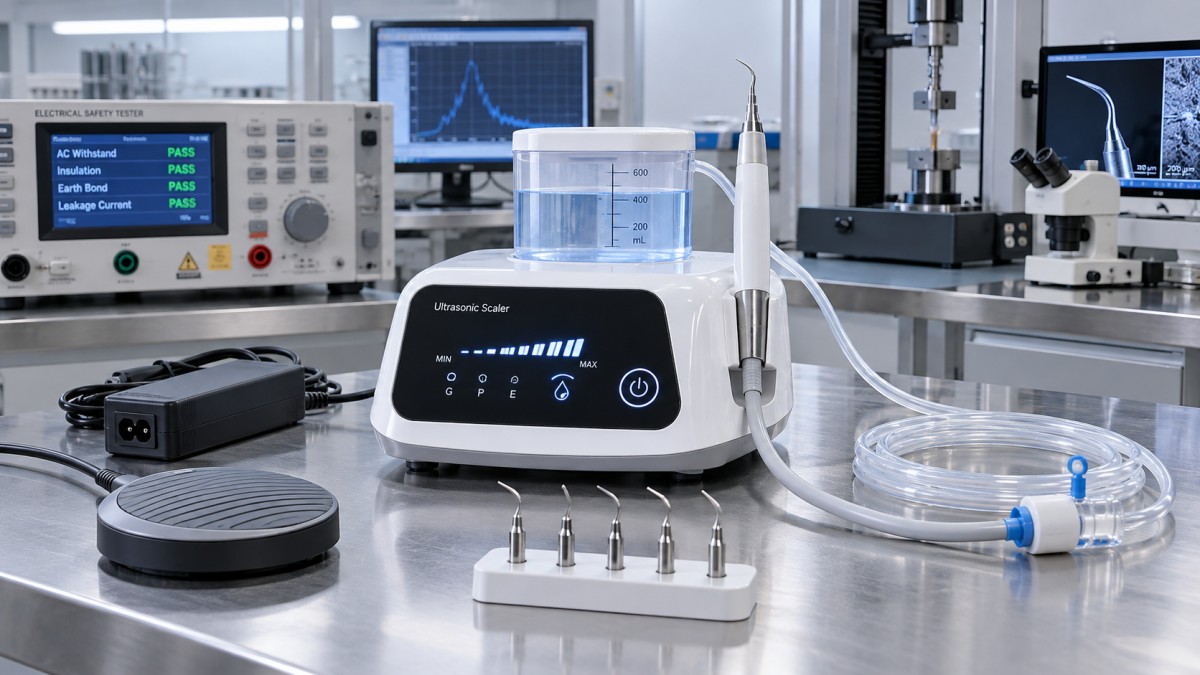
Ultrasonic scalers are active electrical devices, often used near patients, dental chairs, water lines, and other powered equipment. The supplier should provide applicable test evidence for electrical safety and electromagnetic compatibility, commonly using standards in the IEC 60601 family where the device falls within their scope.
Electrical safety testing addresses hazards such as electric shock, leakage current, insulation failure, overheating, and mechanical or construction-related risks. Electromagnetic compatibility testing addresses whether the scaler can operate properly in an electromagnetic environment and whether it creates unacceptable interference for nearby equipment.
Reports should be reviewed as technical records rather than marketing attachments. The model number and tested configuration should be visible. Pay close attention to the power supply, handpiece cable, foot control, and accessories listed in the report. A product tested with one external adapter should not be casually shipped with a lower-cost substitute. Changes to a power adapter, cable length, enclosure, or control electronics can require a reassessment of the supporting evidence.
For markets using national electrical marks or local approval schemes, a CE-oriented test report may be useful but may not be sufficient on its own. The importer should confirm local requirements before committing to packaging, labels, or a launch date. A capable supplier will identify which reports it has, where their limits are, and what additional testing may be needed for a destination market.
Biocompatibility cannot be inferred from “medical-grade” materials
Any component that has direct or indirect patient contact needs a defensible material-safety assessment. In an ultrasonic scaler, this can include the tip, handpiece surfaces, irrigation pathways, seals, and other parts exposed to oral fluids or the clinical treatment area. The appropriate evidence is typically structured around the ISO 10993 biocompatibility evaluation framework and the nature, duration, and type of contact.
Buyers should be cautious when suppliers rely only on statements such as “medical-grade stainless steel” or “FDA-approved plastic.” Material descriptions can be relevant, but they do not replace an evaluation of the finished device in its intended use. Surface treatments, adhesives, colorants, residues from manufacturing, and repeated reprocessing can alter the risk profile.
The documentation does not always need to be a large set of standalone laboratory reports for every component. A proper biological evaluation may draw on material characterization, existing data, chemical information, toxicological assessment, and targeted testing. What matters is whether the supplier can show a reasoned evaluation tied to the finished scaler configuration and patient-contact conditions.
This issue becomes especially important when private-label buyers request cosmetic changes. A new coating, a different polymer grip, a revised adhesive, or an alternative water tube may appear minor from a branding perspective but can trigger a compliance review. The commercial team should not treat such changes as separate from the technical file.
Cleaning, reprocessing, and tip compatibility deserve the same scrutiny
Scalers often involve reusable components and detachable tips. The supplier should have validated or otherwise substantiated instructions for cleaning, disinfection, sterilization where applicable, storage, and service. Clear instructions are part of safe use; they also affect clinic adoption, training needs, and complaint exposure.
Ask what can be reprocessed, how many cycles have been considered, which methods are compatible, and whether the instructions correspond to the exact materials supplied. A handpiece marketed as autoclavable should be supported by evidence consistent with repeated exposure to the stated process. If only certain components are reusable, the labeling and user manual should make that distinction unambiguous.
Tip compatibility is another frequent blind spot. Different tip geometries and manufacturers may alter vibration behavior, heat generation, water delivery, and mechanical loading. If a supplier claims compatibility with third-party tips, request the basis for that claim. If it recommends only proprietary tips, assess whether the supply agreement protects continuity of supply, batch traceability, and replacement availability.
Quality-system certification is only useful when it connects to traceability
Certificates matter most when they are reflected in the supplier’s day-to-day controls. Before selecting a partner, buyers should ask how serial numbers or lot numbers are assigned, how complaints are recorded, how field failures are investigated, and how product changes are communicated. These answers often reveal more than a polished certificate package.
For example, a distributor should know whether a change in the ultrasonic generator board, handpiece supplier, tip alloy, firmware, power adapter, or packaging is subject to formal change control. The supplier should be able to determine whether the change affects performance, safety evidence, labeling, registration, or customer notifications. Without that discipline, the product sampled at the beginning of a relationship may drift from the product delivered a year later.
Traceability also matters when a clinic reports inadequate scaling performance, handpiece overheating, leakage, or an unexpected compatibility problem. A supplier that can rapidly identify the production batch, components used, inspection records, and affected customers is far better positioned to contain the issue. This is a procurement criterion as much as a compliance criterion.
How to screen suppliers without turning due diligence into a document chase
The most efficient approach is to define the target market and intended product configuration before asking for certificates. Then request a controlled document package for the exact model under consideration. Avoid accepting a folder of unrelated certificates covering other dental products, expired test reports, or generic declarations with no model identification.
For an initial supplier review, four questions are usually decisive:
- Who is the legal manufacturer responsible for the scaler in the destination market?
- Which compliance documents apply to this exact model, including handpiece, tips, adapter, and accessories?
- What evidence supports electrical safety, EMC, patient-contact materials, and reprocessing claims?
- How will the supplier control changes, trace product, handle complaints, and support a corrective action if needed?
A supplier that answers these questions precisely may still require further commercial and technical evaluation. Yet it has cleared a more meaningful threshold than one that simply displays CE, FDA, or ISO logos on a catalogue page. For ultrasonic scalers, the right certification package is not a badge collection. It is evidence that the supplier understands the device as a clinical product, can support its legal route to market, and can keep the delivered product consistent with the one that was assessed.
Related Intelligence
- Ultrasonic ScalersWhat Certifications Should an Ultrasonic Scaler Supplier Have?What certifications should an ultrasonic scaler supplier have? Explore ISO 13485, CE/MDR, FDA, electrical safety, EMC, biocompatibility, and traceability requirements.
- Ultrasonic ScalersHow to Evaluate a Dental Cleaning Device Manufacturer: Scaling Performance and Service SupportDiscover how to evaluate a dental cleaning device manufacturer for scalable performance, compliance, and reliable service support before you choose a long-term supplier.
- Ultrasonic ScalersPlaque Removal Device USA Buying Guide: Home Scalers, Safety Features, and Compliance BasicsPlaque removal device USA buying guide: compare home scalers, key safety features, and compliance basics to choose a safer, smarter oral care tool.
The Morning Broadsheet
Daily chemical briefings, market shifts, and peer-reviewed summaries delivered to your terminal.
